
Every Sdn Bhd in Malaysia now has an obligation to identify, record, and report its beneficial owner SSM requires visibility on — not just who holds shares on paper, but who actually owns or controls the company behind the scenes. This requirement has been enforced since October 2024, and it’s one that’s easy to overlook if your company hasn’t reviewed its filings recently. Here’s what it covers and what you need to do.
What Is a Beneficial Owner?
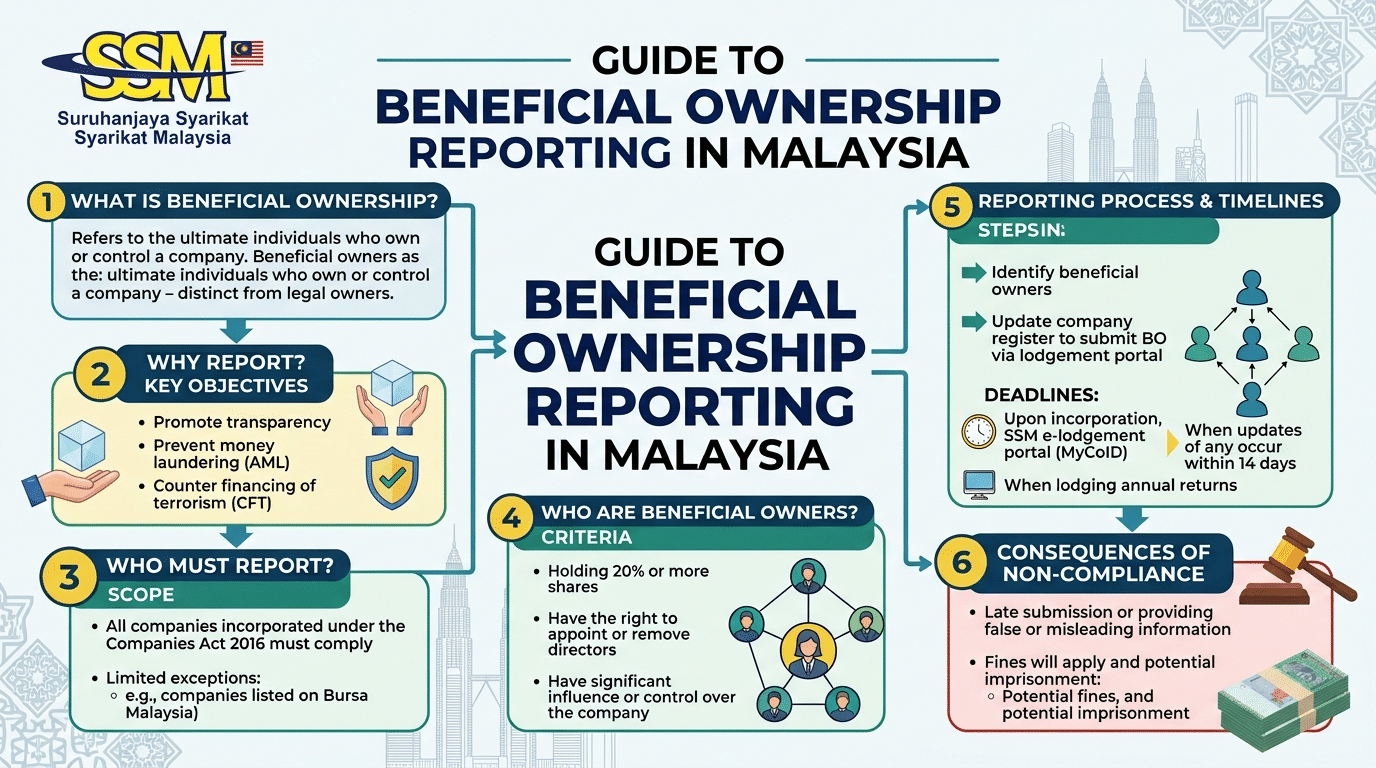
A beneficial owner is the natural person who ultimately owns or controls a company — not necessarily the name that appears on your shareholder register. Under the Companies Act 2016:
- A nominee shareholder, holding shares on someone else’s behalf, is not the beneficial owner — the person they’re holding shares for is.
- For shares, the beneficial owner is generally someone who holds, directly or indirectly, 20% or more of the company’s shares or voting rights, though the full test also looks at other forms of ultimate effective control, not shareholding alone.
- If your Sdn Bhd is owned by another company, including a foreign parent, you need to trace through to the natural persons who ultimately own or control that parent entity — layered ownership structures don’t exempt you.
- Where a trust is involved, the beneficial owner is typically the settlor, a beneficiary, or whoever ultimately benefits from or controls the trust.
- If, after taking reasonable steps, a company genuinely cannot identify a natural person meeting these criteria, senior management who exercise ultimate effective control over the company may be recorded instead, as a fallback.
Beneficial Owner SSM Filing: What You Need to Do
Companies are expected to:
- Take reasonable steps to identify their beneficial owner(s), including reviewing shareholding structures and asking shareholders directly where ownership isn’t obvious from the register.
- Maintain an internal register of beneficial owners at the company’s registered office (or another Malaysian location notified to SSM), recording each beneficial owner’s full name, address, nationality, identification details, and the dates they became or ceased to be a beneficial owner.
- Lodge beneficial ownership information with SSM through the e-BOS (Beneficial Ownership System) platform.
- Keep the information current, updating both the internal register and the SSM filing whenever there’s a change in beneficial ownership.
Individuals who qualify as a beneficial owner also have their own obligation to notify the company of their status — this isn’t purely a one-way obligation on the company.
Beneficial Owner SSM: Enforcement Timeline
SSM gave companies a transition period to get their beneficial ownership filings in order. That grace period ended on 30 September 2024, and enforcement — including fees and sanctions for non-compliance — began from 1 October 2024. If your company hasn’t reviewed and lodged its beneficial ownership information since then, it’s worth treating this as an active compliance gap rather than a future task.
Penalties for Non-Compliance
| Who | Penalty |
|---|---|
| Individuals (e.g. a beneficial owner who fails to notify the company) | A fine of up to RM50,000, imprisonment of up to 3 years, or both |
| Companies and other entities | A fine of up to RM50,000 |
Beyond the direct penalty, incomplete or outdated beneficial ownership records can also complicate due diligence with banks, auditors, and transaction counterparties, who increasingly expect this information to be current and accurate.
Common Situations That Get Overlooked
- Family-owned companies where shares are split just under 20% each among several family members, without anyone checking whether combined or indirect control still triggers the requirement
- Nominee or trustee shareholding arrangements, where the person named on the register isn’t actually the beneficial owner
- Foreign-owned Sdn Bhd companies, where the natural persons behind an overseas holding company were never formally traced and recorded
- Older companies that completed their initial filing during the transition period but haven’t updated it since a change in shareholding
Not sure if your company’s beneficial ownership filing is complete or up to date? Get in touch and we’ll help you review your structure and get it filed correctly.
Frequently Asked Questions
Q: What is a beneficial owner under Malaysian law?
The natural person who ultimately owns or controls a company, generally through holding 20% or more of its shares or voting rights, or through other forms of ultimate effective control — not necessarily the name recorded as the registered shareholder.
Q: Where do I report beneficial ownership information to SSM?
Through SSM’s e-BOS (Beneficial Ownership System) platform, in addition to maintaining your own internal register of beneficial owners at the registered office.
Q: Does every Sdn Bhd need to report a beneficial owner?
Yes. Every company is expected to take reasonable steps to identify its beneficial owner(s), maintain an internal register, and lodge the information with SSM, even if ownership appears straightforward.
Q: What if my company genuinely cannot identify a beneficial owner?
After taking reasonable steps, companies that still cannot identify a qualifying natural person may record senior management who exercise ultimate effective control, as a fallback.
Q: What happens if my company doesn’t comply?
Individuals can face a fine of up to RM50,000, imprisonment of up to 3 years, or both. Companies and other entities can face a fine of up to RM50,000.
Q: When did beneficial ownership enforcement begin in Malaysia?
The transition period ended on 30 September 2024, with enforcement, including fees and sanctions, beginning from 1 October 2024.