Almost every change in a company needs a resolution, but not every resolution is the same. A directors resolution Malaysia companies pass covers decisions the board can make alone, while a shareholders’ resolution is needed for bigger decisions that the law reserves for the owners. Using the wrong one can make the decision invalid.
This guide explains the difference, when you need each, and how a written resolution Sdn Bhd owners use can save you from holding a meeting.
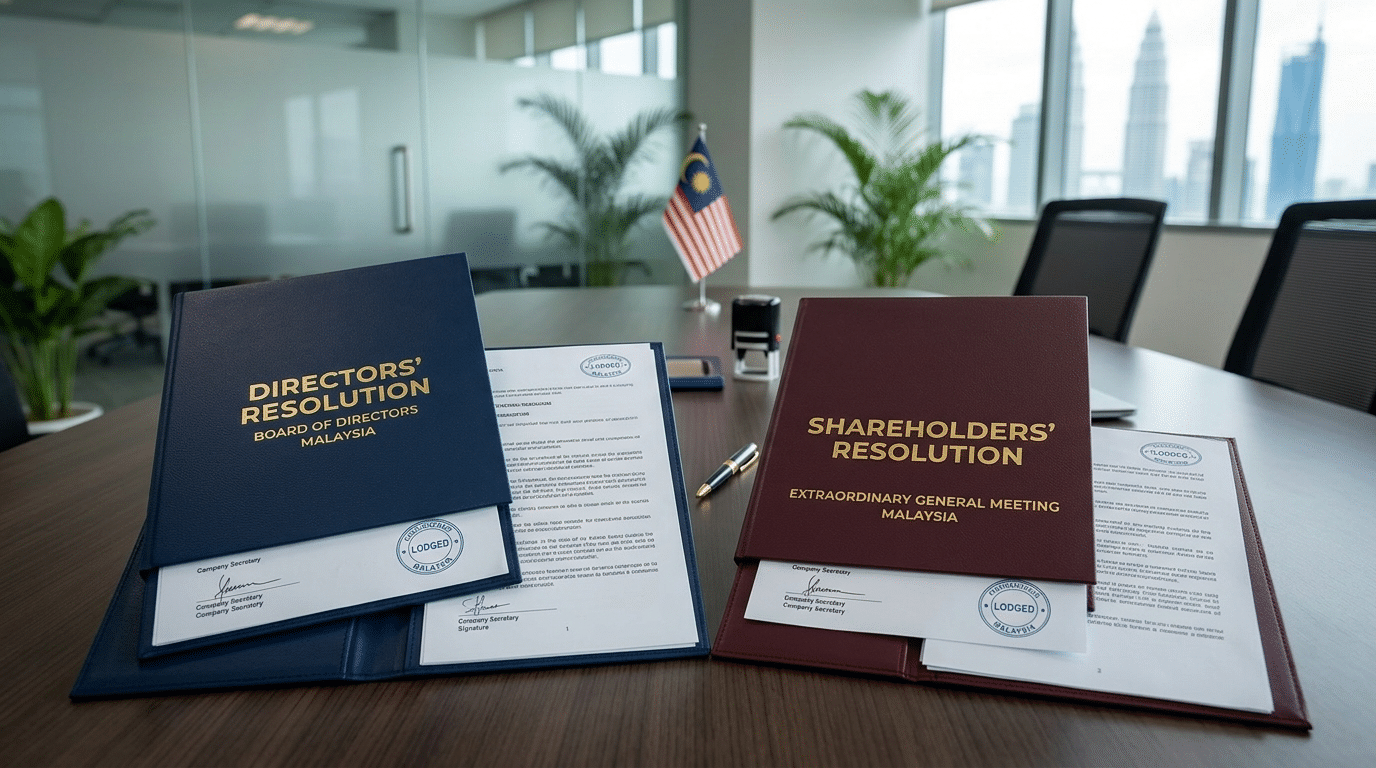
Directors Resolution Malaysia vs Shareholders Resolution: Quick Comparison
| Directors’ resolution | Shareholders’ resolution | |
|---|---|---|
| Who decides | The board of directors | The members (shareholders) |
| Typical decisions | Day-to-day and management matters | Major decisions reserved for the owners |
| Vote needed | Usually a majority of directors, as set by the constitution | Ordinary resolution (simple majority) or special resolution (at least 75%) |
| Can it be in writing? | Yes, as a circular resolution, if the constitution allows it | Yes for private companies, as a written resolution |
| Filed with SSM? | Not as a general rule, but the resulting change often has to be notified | Special resolutions generally have to be lodged with SSM |
What Is a Directors Resolution Malaysia Boards Use?
A directors’ resolution (also called a board resolution) records a decision made by the board. It may be passed at a board meeting or, if the constitution allows, circulated in writing and signed by the directors. Typical examples are:
- Opening or closing a bank account and choosing the signatories
- Appointing or accepting the resignation of officers, including the company secretary
- Approving a share transfer or a change of registered office
- Approving contracts, loans and day-to-day business decisions
- Declaring an interim dividend
Even where the board can decide alone, it is good practice to keep a signed directors resolution Malaysia banks and regulators can ask to see. Banks and regulators often ask for a certified copy. For examples, see How to Change Your Company Secretary and How to Change Company Address in Malaysia.
What Is a Shareholders Resolution?
A shareholders’ resolution (or members’ resolution) is a decision of the owners. It is needed for matters the Companies Act 2016 or the company’s constitution reserves for them. There are two main types:
- Ordinary resolution: passed by a simple majority. Used for matters such as approving the allotment of new shares, adopting accounts and declaring a final dividend.
- Special resolution: passed by at least 75%. Used for bigger decisions such as changing the company name, amending the constitution, reducing share capital or voluntary winding up.
See How to Increase Paid-Up Capital or Issue New Shares and How to Change Company Name in Malaysia for two common examples.
Written Resolution Sdn Bhd Owners Can Use Instead of a Meeting
A private company does not always need to hold a meeting. A written resolution Sdn Bhd members sign can replace a general meeting, as long as the same voting threshold is met. Section 297 of the Companies Act 2016 is the provision usually cited for this.
- Ordinary resolution in writing: a simple majority.
- Special resolution in writing: at least 75% of the total voting rights of the members entitled to vote, not just those who sign.
- Public companies cannot use written resolutions. They must pass resolutions at a general meeting.
- Some matters still need a meeting. For example, removing a director cannot be done by written resolution. See How to Appoint or Remove a Director in Malaysia.
- Check the constitution. It may add limits or procedures.
Written resolutions are very common in small companies where the shareholders are also the directors. They are quick, but they must be signed properly and kept in your records. For meeting requirements, see AGM for Sdn Bhd.
When Do You Need a Directors Resolution Malaysia Companies Cannot Skip?
| Decision | Usually decided by |
|---|---|
| Opening a bank account | Directors |
| Appointing a company secretary | Directors |
| Changing the registered office | Directors |
| Interim dividend | Directors |
| Allotting new shares | Shareholders first, then directors |
| Changing company name | Shareholders (special resolution) |
| Amending the constitution | Shareholders (special resolution) |
| Final dividend | Shareholders, on the directors’ recommendation |
| Removing a director | Shareholders at a general meeting |
Some decisions need both a directors resolution Malaysia law expects and a shareholders’ one. A share issue, for example, needs shareholder approval and then a directors’ resolution to carry it out. This is only a general guide, and your constitution can change who decides what, so check before you rely on it.
Lodging, Record Keeping and Common Mistakes
- Special resolutions generally have to be lodged with SSM, usually within 30 days. Confirm the deadline for your case with your company secretary.
- Keep every resolution in your statutory records. Written resolutions should be dated and signed by the required members, and the date is when the last required member signs.
- Do not backdate. Record the decision at the time it is made.
- Do not use the wrong type. A matter that needs a special resolution cannot be passed by a simple majority.
- Do not forget the follow-up filing. A directors resolution Malaysia companies pass is only the first step. Many changes still need to be notified to SSM on time. See Common Company Secretarial Mistakes.
Not sure which resolution your company needs? See our Company Secretary services or get in touch, and we can prepare the right resolution for your situation.
Frequently Asked Questions
Q: What is the difference between a directors resolution and a shareholders resolution?
A directors’ resolution records a decision made by the board, usually on management matters. A shareholders’ resolution is a decision of the members on bigger matters reserved for the owners, passed as an ordinary or special resolution.
Q: What is the difference between an ordinary and a special resolution?
An ordinary resolution needs a simple majority. A special resolution needs at least 75% of the votes, and is used for major decisions such as changing the company name or the constitution.
Q: Can a Sdn Bhd pass resolutions without holding a meeting?
Yes. A private company can pass members’ written resolutions instead of holding a general meeting, provided the required voting threshold is met. Public companies cannot.
Q: Does a written resolution need every shareholder to sign?
Not always. It needs enough signatures to meet the threshold, a simple majority for an ordinary resolution and at least 75% of the total voting rights for a special resolution. Check your constitution for extra rules.
Q: Do resolutions have to be filed with SSM?
Special resolutions generally have to be lodged with SSM, usually within 30 days. Many ordinary resolutions are not lodged, but the change they approve may still need to be notified.
Q: Who prepares the resolutions for my company?
Usually your company secretary, who drafts them, keeps them in your records and files anything that has to go to SSM.